


|
Bodhidharma - the legendary First Ancestor
|
How much of the story of Bodhidharma is legend? The actual teachings of Bodhidharma are not fully known, and we find the first notice of the "blue-eyed barbarian" (as later Chinese called him) a century after he came to China, at which time Bodhidharma had not yet been anointed the First Ancestor of Zen: rather he was merely one of a number of priests teaching meditation. Although his first full biography (ca.645) makes no particular fuss over him, less than a century after this he was declared the founder of Zen, provided with a lineage stretching directly back through Nagarjuna to the Buddha—Bodhidharma as the 28th Ancestor in the line beginning with Shayamuni Buddha.
|
Bodhidharma—man and myth—was the product of an early form of Zen. The later masters needed a lineage, and he was tapped for the role of First Ancestor, even though many of his ideas were in direct contradiction to the position adopted by later Zen teachings, for instance his promoting reliance on a sutra (the Lankavatara)
Yet as founders go, he was a worthy individual. He does seem to have devised a strain of Buddhist thought that could successfully be grafted onto the hardy native Chinese Taoist organism. And Bodhidharma remains—before fact and fiction—a preeminent archetype for the profound liberations science called Zen. He also left an active disciple, later to be known as the Second Ancestor, Huike, so he must have had either a charismatic personality or a philosophical position that distinguished him from the general run of meditation masters.

If Buddhist texts and monks had been arriving in China for centuries (remember the Emperor who summoned Bodhidharma considered himself a scholar of Buddhism), what did Bodhidharma bring with him? In place of stale scholarship, focusing on translation of texts, and the building of temples, he brought the experience of wisdom achieved through direct awakening (the same experience as Shakyamuni Buddha's and Mahakashyapa's) and the transmission of enlightenment from master to disciple.
One of the enduring legends of Bodhidharma attributes this verse of Zen:
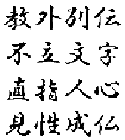
A special transmission outside the scriptures
Depending not on words and letters;
Pointing directly to the human mind;
Seeing into one's nature, one becomes a Buddha.
 |
 |