

The Life of Sakyamuni Buddha (continued)DeathThe life story of the Buddha is part of the doctrinal heritage of the Buddhist tradition. One of the reasons for telling these stories is to remind us of the Buddha’s underlying humanity and to show us the potential in our own lives. In this part of the story, the Buddha takes time to talk about his impending death. "O Ananda, my body is old and decaying; and my journey is drawing to its close. I am turning eighty years of age. Just like a worn-out cart, my body is neither sturdy nor strong. Have I not taught you before that for birth and for death there is a time, and that there is no one who once born is not bound to death? Born in this world, I have discovered the path to nirvana and severed the root of delusion. Therefore after I am gone be not negligent about this Dharma." "O Ananda, let yourself be your light and your refuge; seek no other refuge. Let the Dharma be your light and your refuge; seek no other refuge. " This dialogue between the Buddha and Ananda is similar to one that many of us have heard, if not actually participated in. It is a dialogue where a person shares the pains of what it means to grow old: "my body is old and decaying." It is a conversation we have that is also often filled with the anxiety of perhaps no longer being able to escape the inevitability of our mortality; the great change we call death. Death is something we know, but at the same time try to deny. This contradiction is often the source of our anxiety. The great hope that the Buddha shares with us in this story, however, is the fact that the Buddha is completely settled about his own impending death. There is neither remorse nor anxiety in the Buddha. He imparts his settled nature by reminding us yet again of the humanity we share. The Buddha cannot escape the truth of death. He cannot escape because, like us, he was "born in this world." However, unlike most of us, the Buddha has severed the root of delusion. He is able to see his life clearly, as it is. He reminds us that it was the Dharma that allowed him to see. Even during the last moments of his life sharing the Dharma is what brought him light, whereas others would only see darkness. What helps to make this story so intriguing and unique is the fact that this was the most opportune time for the Buddha to say to Ananda, "If you believe in me, you will be saved." In this situation, during the moment of our greatest weakness, we sometimes try to overcome our fears and mask our doubts by pushing our unproved belieft onto others. If the other person even remotely acknowledges our claim, we use that affirmation as surrogate proof for the accuracy of our claim. “Because you believed what I said, my belief cannot be wrong,” is the argument we make. We push our doubts onto others in order to seek proof that we are not mistaken.
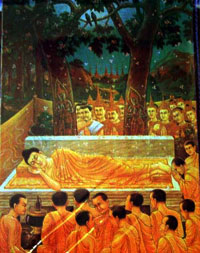
The Buddha, on the other hand, tells Ananda with complete confidence, "…let yourself be your light and your refuge; seek no other refuge." In these few words the religious spirit of the Buddha is clearly revealed. He seems to tell us that the reason for holding to a religious belief is to be able to live life well. In other words, if a religion cannot help us to live our lives in its entirety, from beginning to end, with courage; free from fear and anxiety, and purpose; helping others to live their lives without regret as well, then there is no point to that religion. In revealing this attitude to us, the Buddha shares the final chapter of his life by showing us a life that is filled with both courage and purpose, even when confronting death. He accepts the totality of his life, including his death, without fear. Instead of worrying about his death he seeks to console his disciples and teach them how they too can live a life that is filled with courage and purpose until the final moment. The Buddha reminds us that he too is human, and his human life will end. The Buddha shares the Dharma with us as a person who has himself experienced the liberating power of Truth: “…let the Dharma be your light and your refuge; seek no other refuge.” The end of the Buddha’s life and his earthly career as teacher, guide, and inspiration was recorded by his disciples in the following way.
The disciples could not bear their grief;
some pounded their chests and wept, and some fell to the
ground mourning in anguish. Everyone was saddened at the
thought, “Why so soon has the Eye of the World closed?
From today who is going to guide all of us disciples? On
whom are we, the disciples, to rely? There are three unhappy
destinies that always open up in front of us, but the gate
of emancipation is totally closed to us.” Anuruddha then
exhorted them, “Enough, my brethren, be not grieved nor
lament. Has not the World-Honored One, moments ago, taught
us that all things are equally impermanent in both their
nature and their form?” Whereas the Buddha’s life ended without anxiety, the same could not necessarily be said for those who survived him. Perhaps it goes without saying how difficult it was to lose such a wonderful role model, mentor, inspiration, and guide. However, if we are unprepared for the death of another, how are we to prepare for our own death? This was the final challenge that the Buddha tried to help us to overcome. As mentioned previously, the fact that we continue to share our stories of growing old while trying to hide from our mortality is one of the reasons why life is often filled with anxiety. If this is how we approach death, then we clearly belong to that group of disciples that could not appreciate the final words of the Buddha. Fortunately for us, the treasure of the Dharma and the light of the Buddha are still a part of our world.Buddha. He was noted as being foremost in "divine vision." |
 |
